

Launching paid advertising without validating your landing page is one of the most expensive mistakes marketers still make.
Whether you run Google Ads, Meta Ads, LinkedIn Ads or TikTok Ads, the reality is always the same:
👉 your ads don’t convert, your landing page does.
And yet, most landing page analyses available today are:
- too generic,
- not built for paid traffic,
- disconnected from real ad performance constraints.
In this article, we’ll explain:
- why traditional landing page analysis falls short for ads,
- what really makes a landing page convert paid traffic,
- how comparing two landing pages (including competitors) changes decision-making,
- and how Adsroid brings an Ads-first AI approach to landing page analysis.
Why Landing Page Analysis Is Different for Paid Ads
Organic traffic and paid traffic behave very differently.
With paid ads:
- users arrive with high intent but low patience,
- the cost of every click matters,
- weak pages don’t just underperform, they burn budget.
A landing page optimized for SEO or branding is not automatically optimized for ads.
Paid traffic requires:
- immediate message clarity,
- frictionless conversion paths,
- strong trust signals above the fold,
- perfect alignment between ad promise and page content.
Most tools analyze landing pages from a UX or SEO perspective.
Very few analyze them from a media buyer’s perspective.
That’s the gap Adsroid is designed to fill.
The Limits of Generic AI Landing Page Analysis
Yes, you can paste your URL into a generic LLM and ask:
“Is my landing page good?”
But the answers are often:
- theoretical,
- repetitive,
- disconnected from your advertising context.
Generic AI usually:
- assumes user behavior without data,
- ignores ad platform constraints,
- mixes UX best practices with vague advice.
What’s missing is context.
An AI analyzing landing pages for ads must understand:
- traffic source (Google Ads vs Meta vs LinkedIn),
- device focus (mobile vs desktop),
- conversion goal (lead generation vs signup vs purchase),
- and the role of the page inside a paid funnel.
Adsroid was built with this context at its core.
What Really Matters for Landing Pages Used in Ads
When Adsroid analyzes a landing page, it focuses on elements that directly impact paid performance, such as:
1. Message Clarity Above the Fold
Can a user understand:
- what you do,
- who it’s for,
- and why it matters
within a few seconds after clicking an ad?
If not, paid traffic will bounce, no matter how good your ads are.
2. Conversion Path & Friction
Paid traffic needs:
- clear CTAs,
- minimal form friction,
- no unnecessary navigation leaks.
Adsroid detects:
- missing or weak CTAs,
- forms that create unnecessary friction,
- distractions that hurt conversion.
3. Trust Signals for Cold Traffic
Paid ads bring cold users.
That means trust must be established fast:
- testimonials,
- client logos,
- social proof,
- legal clarity.
Adsroid evaluates whether these elements are detectable and visible from a paid traffic perspective.
4. Ads Alignment (Message Match)
A landing page can be “good” and still fail ads.
Why?
Because the message doesn’t match the ad intent.
Adsroid flags inconsistencies between:
- expected ad promises,
- and what the page actually delivers.
Comparing Two Landing Pages: A Game Changer for Ads
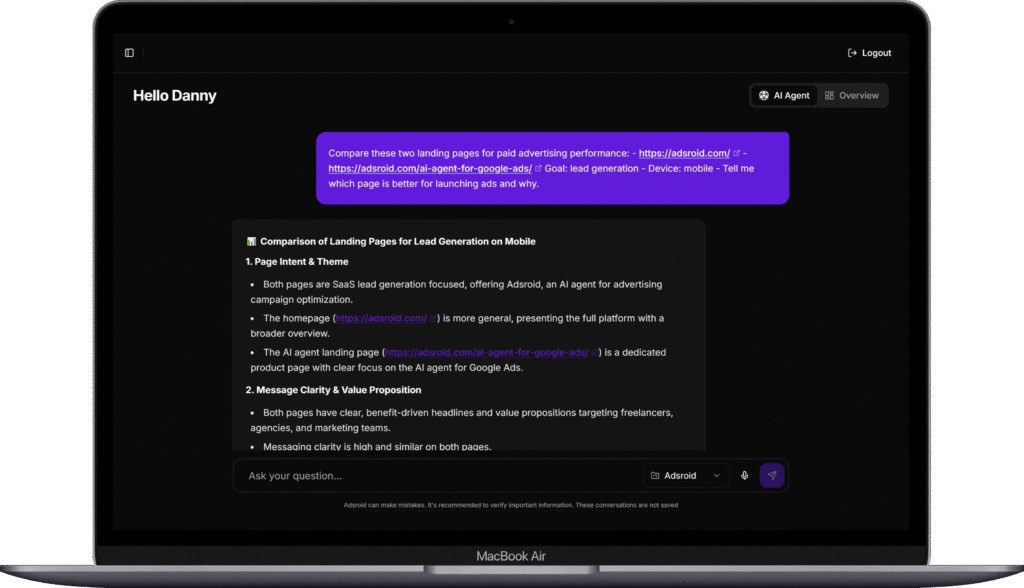
One of the most powerful ways to improve ad performance is comparison.
Marketers constantly ask:
- “Is my landing page better than my competitor’s?”
- “Why are their ads working and mine aren’t?”
- “Which page should I send traffic to?”
Adsroid now allows:
- side-by-side analysis of two landing pages,
- including competitor pages,
- with a clear verdict on which one is more suitable for paid ads.
Not based on opinions, but on:
- structure,
- conversion logic,
- trust,
- clarity,
- and ad readiness.
This helps you:
- avoid launching ads on weaker pages,
- understand competitive advantages,
- prioritize fixes before spending budget.
Why Adsroid Is Different From Other AI Tools
Adsroid is not a generic website analyzer.
It is an AI agent built specifically for advertising performance.
That means:
- no assumptions when data is not detectable,
- no invented metrics,
- no vague UX advice.
Adsroid analyzes:
- static HTML only (what ads platforms actually see),
- clearly states limitations,
- provides actionable, conservative recommendations.
Every analysis is framed around one question:
Will this page convert paid traffic efficiently?
Tested on Real Advertising Use Cases
The methodology behind Adsroid’s landing page analysis has been tested across:
- SaaS homepages,
- lead generation funnels,
- startup landing pages,
- consultant and agency websites.
The goal is always the same:
👉 reduce wasted ad spend by fixing landing page issues before launch.
When to Use Landing Page Analysis Before Ads
You should analyze (or compare) landing pages if:
- you’re about to launch a new ad campaign,
- your ads get clicks but no conversions,
- you hesitate between multiple pages,
- you want to benchmark against competitors,
- you want faster learning before scaling.
Landing page analysis is not an afterthought, it’s a precondition for performance.
Final Thoughts
Paid advertising doesn’t fail because of ads alone.
Most of the time, it fails because:
- the landing page is not built for paid traffic,
- conversion friction is underestimated,
- trust is missing for cold users.
Adsroid brings landing page analysis inside the advertising workflow, where it belongs.
From ads → to landing pages → to conversion decisions,
Adsroid aims to become your end-to-end AI agent for ad performance.

