
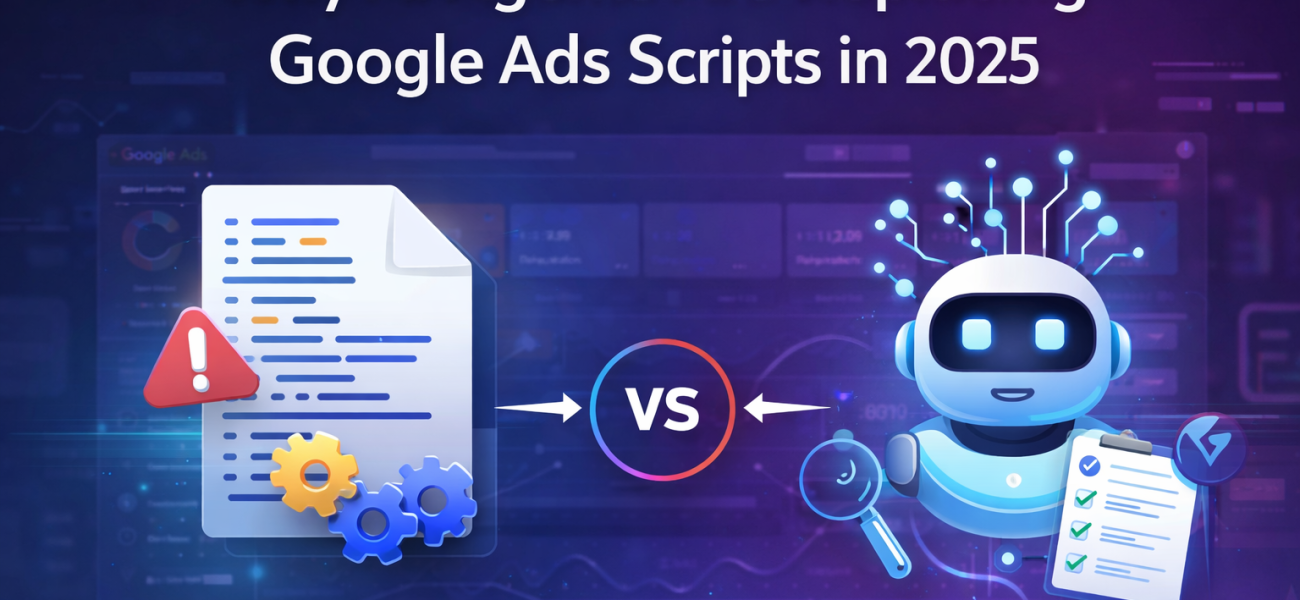
Let’s be clear: scripts are powerful tools.
They can:
- pull data
- apply predefined logic
- automate repetitive actions
- save time on execution
But scripts are fundamentally limited by design.
A script:
- follows static logic
- has no understanding of context
- cannot prioritize conflicting signals
- does not explain its decisions
- does not learn from past outcomes
- cannot interact with humans naturally
In other words:
Scripts execute instructions.
They do not reason about outcomes.
That difference matters more than ever.
The real issue: Ads optimization is not linear
Most Google Ads optimizations look simple on paper.
But in reality:
- improving CPL may reduce volume
- increasing budget may worsen efficiency short-term
- pausing keywords may impact smart bidding learning
- fixing one campaign can hurt another
Experienced media buyers know this instinctively.
Scripts don’t.
This is why most “advanced” scripts eventually become:
- overly conservative
- overly aggressive
- or silently dangerous
They lack judgment.
What an AI agent really is (and what it is not)
An AI agent is not:
- a script with GPT attached
- a smarter rule
- another dashboard
A real AI agent is a system that can:
- Observe
Continuously monitor account data, performance trends, and anomalies. - Reason
Understand trade-offs, context, and historical behavior. - Recommend
Propose actions with explanations, risks, and expected impact. - Act (optionally)
Execute changes — ideally with human validation. - Learn
Improve decisions over time based on outcomes.
This is a qualitative leap, not an incremental improvement.
Scripts vs AI agents: a concrete comparison
| Google Ads Scripts | AI Agents |
|---|---|
| Execute predefined logic | Reason about data |
| Static rules | Adaptive decisions |
| No memory | Context + history |
| No explanation | Explainable recommendations |
| Reactive | Proactive |
| No interaction | Conversational |
Scripts answer:
“What should I do if X happens?”
AI agents answer:
“What should I do now, given everything I know?”
Real-world questions scripts cannot answer
Try asking a script:
- “Why did spend spike yesterday?”
- “Which campaigns should receive budget today?”
- “What’s the risk if I pause this keyword?”
- “Summarize my account performance for my client.”
- “What should I focus on first this morning?”
These are the actual questions advertisers ask daily.
And they require:
- context
- prioritization
- explanation
- and often, human judgment
This is where AI agents shine.
Why conversational interfaces change everything
Another major shift is how advertisers interact with their accounts.
Dashboards require:
- time
- attention
- interpretation
Conversational interfaces remove that friction.
Instead of digging through tabs, filters and reports, advertisers can simply ask:
“What’s hurting performance today?”
“Where should I move budget?”
“Do you recommend taking action now or waiting?”
This is not just more convenient.
It fundamentally accelerates decision-making.
Where Adsroid fits in this shift
Adsroid is built around a simple idea:
Advertising doesn’t need more automation.
It needs better decisions.
Adsroid is an AI agent designed specifically for advertising:
- Google Ads first
- conversational by default
- recommendation-driven
- human-in-the-loop
- multi-platform by design
It doesn’t blindly execute changes.
It analyzes, explains, and proposes — then acts only when validated.
Think of it as a copilot, not an autopilot.
Scripts won’t disappear — they’ll be orchestrated
This is important:
AI agents are not here to kill scripts.
Scripts will continue to exist but as execution tools, orchestrated by higher-level reasoning systems.
In 2025, the winning advertisers won’t be those with:
- more rules
- more scripts
- more dashboards
They’ll be the ones with clearer decisions, faster feedback loops, and better judgment at scale.
That’s exactly where AI agents are heading.
Final thought
Google Ads is no longer a system you “optimize”.
It’s a system you manage, arbitrate, and steer.
And that requires more than automation.
It requires intelligence.
That’s why AI agents are replacing Google Ads scripts and why this shift is only just beginning.

