
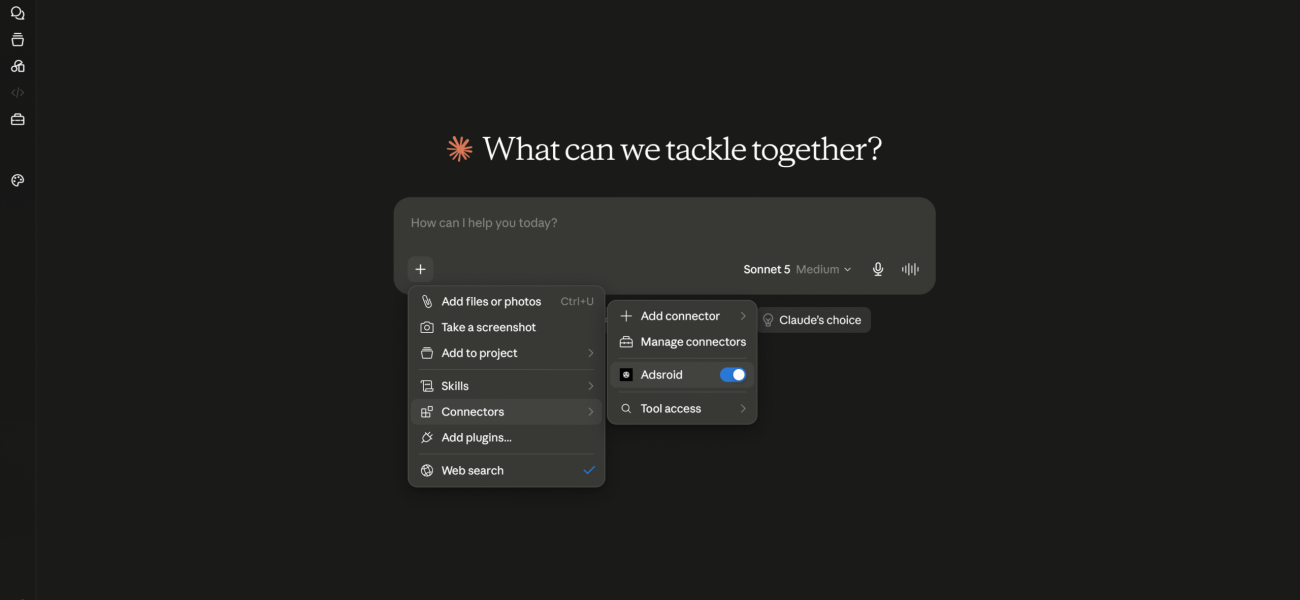
AI has become remarkably good at analyzing marketing problems.
But there has always been a gap between understanding advertising and actually working inside an advertising account.
Your AI can tell you that a campaign is underperforming.
But can it check the live data?
Can it identify the campaigns responsible?
Can it build a new campaign?
Can it adjust budgets, pause keywords, analyze search terms, or compare performance across multiple accounts?
And can it do all of that without forcing you to build and maintain a separate integration for every advertising platform?
That is what we built Adsroid MCP to solve.
Today, Adsroid MCP is live.
It gives Claude and other MCP-compatible AI assistants a single connection to your advertising ecosystem, with 140+ tools to analyze, manage, create and optimize campaigns.
One MCP. Multiple advertising platforms.
Most advertising integrations are built around a simple model:
One platform → one integration → one account → one context.
That works until your advertising setup becomes more complex.
You might have Google Ads for one business, Meta Ads for another, multiple accounts under an MCC, GA4 for analytics, Search Console for organic performance, and competitive intelligence through Ad Radar.
Connecting each of these systems independently creates a fragmented AI experience.
Adsroid MCP takes a different approach.
One endpoint connects your AI to your advertising ecosystem.
The same MCP connection can provide access to Google Ads, Meta Ads and the broader Adsroid ecosystem, with additional platforms continuously being added.
Instead of switching between tools and contexts, you can ask your AI to work across them.
For example:
“Compare Google Ads and Meta Ads performance for this month and tell me where we’re getting the best acquisition efficiency.”
Or:
“Find the campaigns spending more than €500 this month without a conversion and show me what you would change.”
The AI can retrieve the relevant data, reason about it, and continue the conversation.
From analysis to execution
This is where Adsroid MCP becomes fundamentally different from a simple reporting integration.
It isn’t read-only.
Adsroid MCP allows AI to interact with advertising platforms and perform actions according to the permissions and capabilities of the connected platform.
That means a conversation can move from:
Analyze → Decide → Execute
Instead of:
Analyze → Open dashboard → Find campaign → Make changes manually
Imagine asking:
“Give me a performance overview of all my campaigns this month and flag anything significantly below target.”
Claude can retrieve the live campaign data and identify the areas that need attention.
You can then follow up:
“Pause the worst-performing campaign and reduce the target CPA on the other one.”
Claude can identify the requested changes and ask for confirmation before applying them.
This is the difference between giving AI access to information and giving AI the ability to work with your advertising systems.
140+ tools built for advertising
We didn’t want to build another generic MCP wrapper that exposes a handful of API endpoints.
Advertising platforms contain enormous amounts of specialized data and functionality.
Google Ads alone requires understanding campaigns, ad groups, keywords, search terms, bids, budgets, conversions, Quality Score, experiments and much more.
Adsroid MCP currently provides 140+ advertising tools, including deep Google Ads and Meta Ads functionality.
For Google Ads, that means tools designed around real advertising workflows, not just generic API access.
You can work with:
- Campaign performance
- Budgets and bids
- Keywords
- Search terms
- Ads
- Quality Score
- Experiments
- Conversions
- Campaign creation
- Optimization workflows
And the same architecture extends across other platforms.
Depth matters as much as breadth.
Connecting ten platforms with five shallow tools each isn’t necessarily useful.
An AI that has access to the right advertising primitives can actually reason about what is happening and what should happen next.
Your AI doesn’t just see your data. It understands your business.
This is one of the parts we’re particularly excited about.
Most AI integrations stop at account data.
They can see:
- Spend
- Clicks
- Conversions
- ROAS
- CPC
- Campaign names
But they don’t necessarily know why the business exists.
Adsroid MCP adds another layer: business context.
Your Adsroid project can contain information about your positioning, audience, unique selling points, pain points and goals.
That context is available to the AI alongside your advertising data.
So instead of asking:
“Which campaign has the lowest CPA?”
you can eventually ask questions closer to how a real marketer thinks:
“Which campaigns are attracting customers that actually match our target audience?”
Or:
“Based on our positioning, which search terms should we consider expanding into?”
The goal isn’t to make AI better at reading dashboards.
The goal is to make AI better at making marketing decisions.
Built for multiple accounts
Advertising rarely lives in a single account.
You might manage multiple brands, markets, businesses, or client accounts.
With Adsroid MCP, multiple projects and accounts can be connected through the same MCP endpoint. Claude can resolve the relevant account based on the context of your request.
That opens up workflows that are difficult with single-account integrations.
For example:
“Which of our e-commerce accounts has the highest ROAS this month?”
Or:
“Compare CPC trends across our Google Ads accounts and identify the biggest anomalies.”
Or:
“Show me the three accounts where spend increased the most while conversions decreased.”
Instead of opening multiple dashboards, exporting reports and building spreadsheets, the analysis can happen directly inside the conversation.
One connection instead of a stack of integrations
There is another important advantage to the single-endpoint approach.
Every advertising platform has its own:
- Authentication
- API structure
- Data model
- Rate limits
- Permissions
- Terminology
Building and maintaining these integrations independently is expensive and fragile.
Adsroid MCP abstracts that complexity behind a single interface.
One endpoint. One authentication flow. Multiple platforms.
From the AI’s perspective, the underlying platform becomes much less important.
It simply has access to the tools it needs.
No development environment required
MCP can sound technical.
But using Adsroid MCP doesn’t require you to build an MCP server yourself.
There is no infrastructure to deploy.
No API wiring.
No token management.
No custom integration to maintain.
The setup is designed to take less than two minutes: connect the Adsroid MCP endpoint to your MCP-compatible client, authenticate with your Adsroid API key, and start talking to your accounts.
Adsroid MCP works with Claude.ai, Claude Code, Claude Desktop and other MCP-compatible clients.
That means marketers can use it without becoming developers, while developers can use the same endpoint as a clean abstraction layer over multiple advertising APIs.
Built with zero data retention
Giving an AI access to advertising accounts naturally raises an important question:
What happens to the data?
Adsroid MCP is designed around real-time requests.
When Claude makes a tool call, Adsroid authenticates the request, resolves the relevant project and account, calls the underlying advertising platform API, and returns the result.
The advertising data isn’t stored, cached or logged at the MCP server level.
The goal is simple:
Route the request. Return the result. Don’t keep the data.
MCP is becoming the interface between AI and software
The bigger idea behind this launch goes beyond advertising.
MCP changes the relationship between AI and software.
Instead of building a custom AI interface for every application, an AI assistant can connect to standardized tools and services.
The AI becomes the interface.
You describe what you want.
The model determines which tools it needs.
The tools retrieve information or execute actions.
And the conversation becomes the workflow.
Advertising is particularly well suited to this model because marketers already work through a combination of analysis, decision-making and repetitive execution.
MCP allows those steps to happen in one place.
What’s next for Adsroid MCP?
Google Ads and Meta Ads are live today, alongside the existing Adsroid intelligence layer.
But we’re building the architecture for something much bigger.
Microsoft Ads, LinkedIn Ads, TikTok Ads, HubSpot and additional marketing platforms are being added to the ecosystem.
The objective is not to create another dashboard.
It’s to create a unified intelligence layer for the entire marketing stack.
One endpoint.
Multiple platforms.
Multiple accounts.
Real-time data.
Business context.
And AI that can actually take action.
Your AI, inside your ad accounts.
This launch is the beginning of a different way of working with advertising.
Instead of asking AI for advice and then manually executing it, you can give your AI the tools it needs to work directly with your advertising systems.
Analyze.
Understand.
Decide.
Execute.
All through a conversation.
Adsroid MCP is now live.
One MCP. Every ad platform. Any conversation.

