
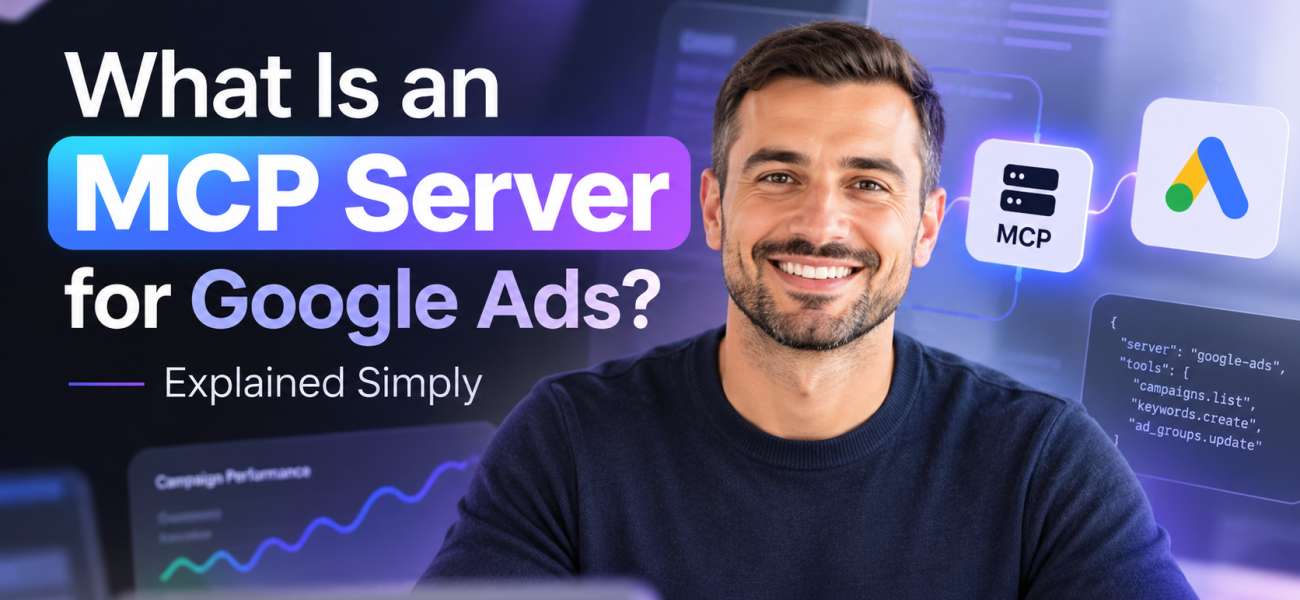
If you’ve been hearing “MCP server” everywhere lately and you’re still not totally sure what it means for your Google Ads account, you’re not alone, it’s one of the most common questions advertisers ask us right now.
In this guide (and the video below), we break down what MCP actually is, why it matters if you manage ad accounts, and what it can realistically do today.
What does MCP actually mean?
MCP stands for Model Context Protocol. It’s an open standard, originally introduced by Anthropic, that lets AI models, like Claude or ChatGPT, connect to external tools and data sources in a structured, secure way.
Think of it as a universal plug. Before MCP, an AI model could only talk to you inside a text box. It had no way to see your actual accounts, pull your actual data, or take any real action on your behalf. MCP changes that: it lets an AI model connect directly to an app or platform, almost like giving it a set of hands and eyes inside that system.
Practically speaking, an MCP server is the piece of infrastructure that exposes a platform’s data and actions, in this case, Google Ads, to an AI model in a format it can understand and use.
Why MCP matters for Google Ads accounts
Managing a Google Ads account today usually means jumping between dashboards, checking reports, digging through search terms, and adjusting bids, a lot of manual, repetitive work, even for experienced advertisers.
With an MCP server connected to Google Ads, you can ask a question in plain English: “show me which campaigns wasted the most budget last week” and get a real answer pulled directly from the account’s live data. No exporting spreadsheets, no clicking through ten report screens.
This is the shift MCP represents: it turns an AI model from “just a chatbot” into something that can actually plug into the tools advertisers already use every day.
Read-only vs. full-access MCP servers
Not all MCP servers work the same way, and this distinction matters a lot when you’re choosing one:
- Read-only MCP servers can pull data and answer questions, but they can’t change anything in the account. You ask, they answer, that’s the whole interaction.
- Full-access MCP servers go a step further and can actually take actions inside an account: creating campaigns, adjusting budgets, updating keywords. Reputable ones include a confirmation step before anything changes, so a human stays in control.
A read-only tool is essentially a smarter reporting dashboard. A full-access tool is closer to having an assistant who can actually do the work, not just describe it.
What you can actually do with an MCP server today
Depending on which server you connect and how much access you grant, common use cases include:
- Asking natural-language questions about performance (“which ad groups have the highest CPA this month?”)
- Auditing search terms and excluding wasted spend
- Pausing underperforming keywords
- Adjusting bids and budgets
- Pulling cross-account or cross-platform reports without leaving your chat window
It’s still early, new MCP servers are being built for different advertising platforms all the time, but the direction is clear: less manual dashboard work, more asking and getting things done.
Try it with your own account
If you want to try this yourself, Adsroid’s MCP server connects Claude directly to your Google Ads (and Meta Ads) account, read access and guided actions, with confirmation before anything changes. There’s a free plan with credits included, so you can test it before paying for anything.
Explore Adsroid’s MCP server →
FAQ
What is an MCP server in simple terms?
An MCP server is a connector that lets an AI model like Claude read data from, and sometimes take actions in, a platform such as Google Ads, instead of only answering questions from a text prompt.
Is MCP the same as an API?
Not exactly. MCP is a standardized protocol built specifically for AI models to discover and use tools and data sources, whereas a traditional API is built for developers to write custom integration code. MCP servers are often built on top of existing APIs.
Can an MCP server change my Google Ads campaigns without asking?
It depends on the server. Read-only servers never make changes. Full-access servers, like Adsroid’s, are designed to confirm actions with you before executing them.
Do I need technical skills to use an MCP server?
No. Once it’s connected (typically a short one-time setup), you interact with it by asking questions or giving instructions in plain English inside Claude or another MCP-compatible AI client.
Which AI models support MCP?
MCP was introduced by Anthropic and is supported natively in Claude (claude.ai, Claude Code, Claude Desktop), with growing adoption across other MCP-compatible clients.

